We want 10% of UK buildings to be Passivhaus by 2030 – it’s a massive challenge
05.12.24 4 min read
The UK has set out challenging carbon reduction targets. Whilst good progress has been made in many areas, the recent debate at COP29 continues to show there is work to do to meet global ambition.
At the Passivhaus Trust, we believe that Passivhaus standards should be a key plank of the UK’s carbon reduction strategy. Passivhaus is a highly rigorous and effective approach to delivering energy efficient, comfortable, and healthy buildings.
However, there is much more to Passivhaus than a lower carbon footprint. Residents of Passivhaus buildings enjoy a range of benefits with homes which are comfortable, healthier, and cheaper to run.
Our own research has identified almost 50 unique benefits of a Passivhaus home. These are bundled into six distinct categories: building performance, climate, health and well-being, people performance, financial, and social.
Some residents of Passivhaus homes in Exeter have not needed to use any heating for five years. As social housing tenants the lack of a heating bill could well be life-changing.
We estimate that around 1% of new homes are built to Passivhaus standards. We hope that by 2030 this can rise to 10% of all buildings in the UK. We also want at least 50% of the industry to understand the principles behind Passivhaus.
It’s a massive challenge. We need to really accelerate delivery.
Part of our role, as an independent, non-profit organisation, is to provide the leadership the industry needs to do just that.
Working directly with placemakers like Muse is central to our approach. Greenhaus, in Salford, is the largest collection of Passivhaus homes in the North West. Designed as affordable homes, residents can enjoy a reduction in their energy bill of up to 90%.
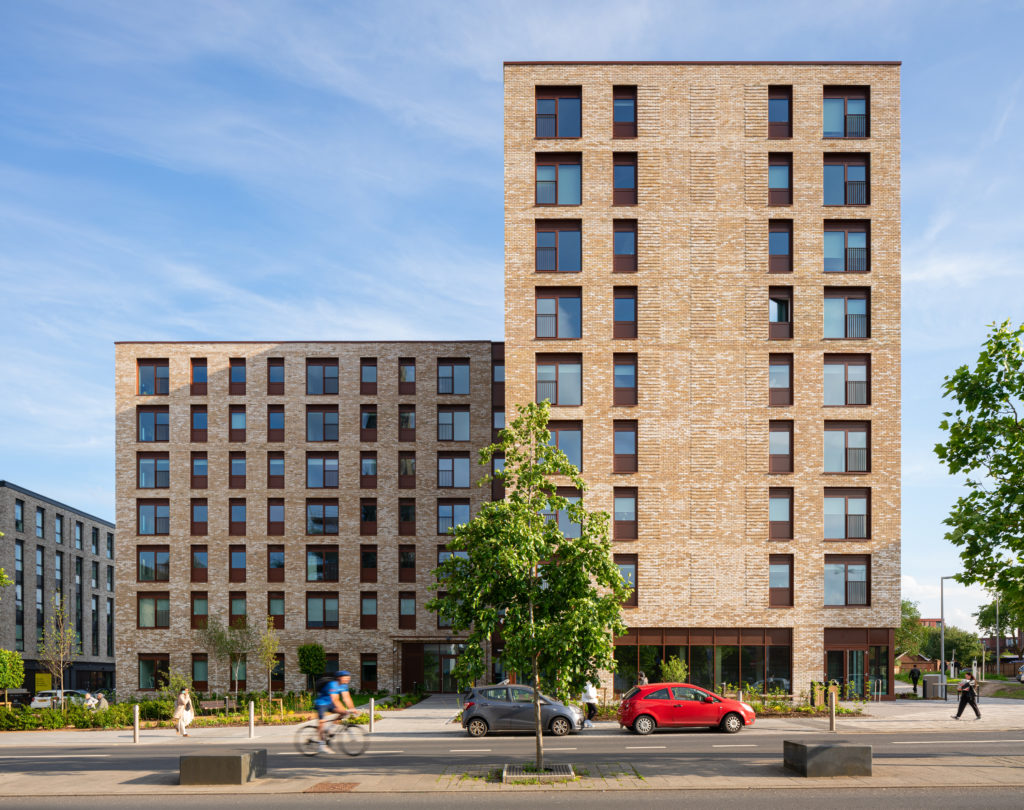
Greenhaus, Salford Central
Earlier this year, Muse became the first largescale placemaker to join the Passivhaus Trust. It’s enabled us to work closely with the team and share the lessons of Greenhaus with the industry.
This has already helped boost confidence. We’ve been able to demonstrate that Passivhaus is a viable approach at scale which can be delivered within manageable timescales and at a reasonable cost.
Muse – alongside the supply chain – has supported open days and public engagement which has helped raise awareness of Passivhaus standards and contributed to a multiplier effect across the industry. Already, Muse have commenced delivery of Willohaus, a further 100 Passivhaus homes in Salford.
To reach our ambitious targets there is much we still need to do. In particular we are working to help clients through the learning curve, so that the extra costs associated with adopting a new approach come down quickly!
The introduction of the Future Homes Standard in 2025 means that Passivhaus is likely to achieve cost parity with the Building Regulations. However, we would still like to see more ambition, especially better fabric & comfort performance, but as an absolute minimum, we would like to see Passivhaus adopted into legislation as ‘deemed to satisfy’ building regulations in a similar manner to that proposed in Scotland.
Nevertheless, once delivered investors, placemakers, and communities can see clearly the benefits of Passivhaus. Our job, working alongside our partners, is to accelerate delivery at scale.