How St Helens is redefining connectivity for a 21st century town centre and designing for movement
23.04.26 4 min read

Connectivity, sustainable transport and active travel are standard components of major town centre regeneration strategies across the UK.
However, in St Helen’s, connectivity isn’t treated simply as supporting infrastructure, it is truly at the heart of the new town centre. It is the starting point and the 24-acre regeneration revolves around the £32 million transport interchange.
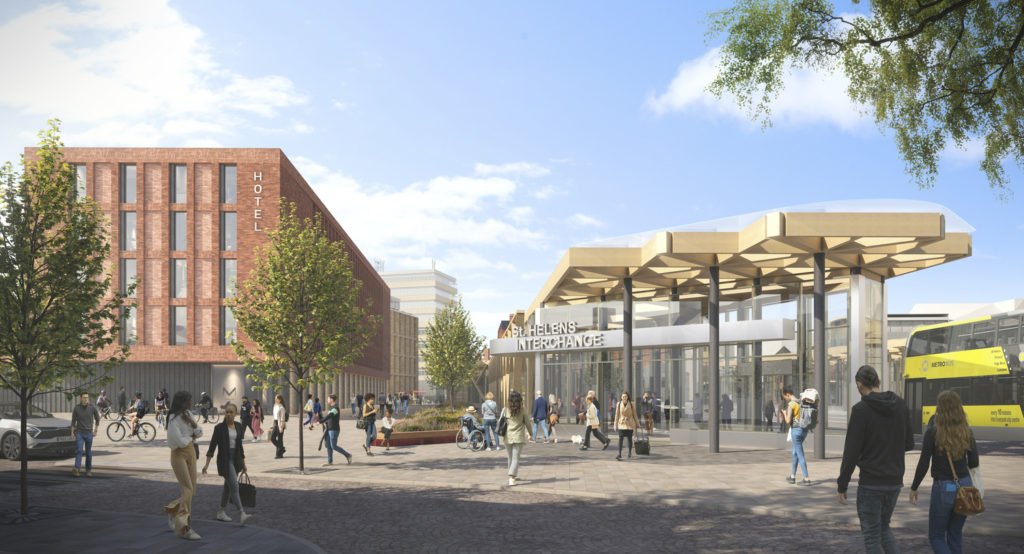
St Helens Transport Interchange
The existing facility was operationally constrained, no longer fit for purpose and didn’t match the wider ambitions for the town centre.
St Helens Borough Council rightly saw the opportunity to create a new interchange as the anchor for the town’s regeneration, recognising that to build confidence and attract investment, plans had to start with how people arrive, move and spend time in the centre.
The new facility will sit alongside the other centrepiece of transformational change in the borough – a revitalised central area featuring a stunning new Market Hall, 120-bedroom Hampton by Hilton hotel, 56 apartments, eight townhouses and 4,266 sq ft of new modern retail, commercial or community space. These will all be set within extensive, biodiversity-rich public spaces designed to support pollinators, native planting, and climate resilience.
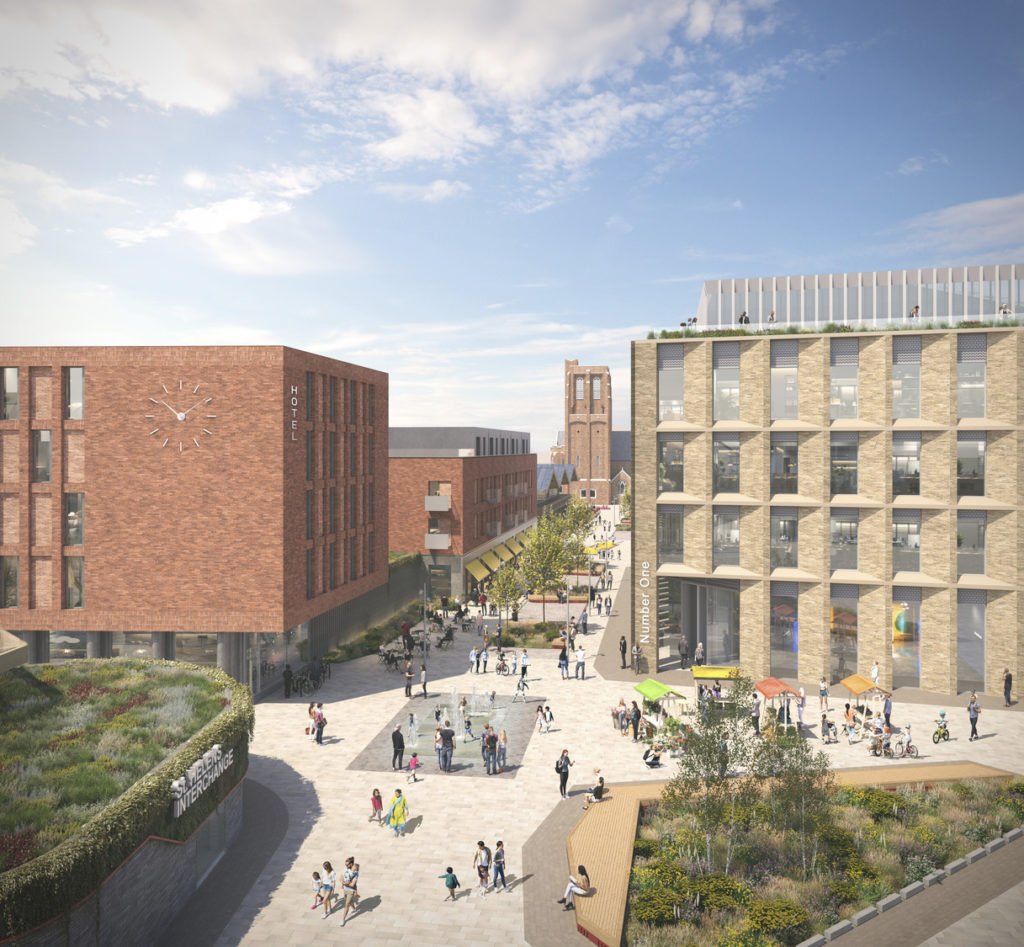
St Helens town centre
This wider masterplan will enable comprehensive redevelopment delivered by the council’s 20-year regeneration partnership with ECF, a supergroup of Homes England, L&G and Muse, we are now bringing that ambition forward.
In terms of the Interchange, this has included a focus on usability, and we have shaped the design of with residents, disability groups, groups representing young people and the elderly, taxi drivers and autism awareness organisations, with the conversations influencing accessibility, acoustics, lighting, colour tones and wayfinding.
This goes beyond cosmetic change.
Planning consent for the Interchange and Phase One has been secured, demolition of the former bus station and Harshaw Shopping Centre are complete, ground works are progressing and the low-carbon steel frame of the interchange is now fully in-situ.
Local context is crucial to understand why this is so important. Bus travel matters in St Helens more than many other towns, in fact, three times as many people commute by bus than do by rail.
To increase footfall, support retail and leisure and create a town centre that works for the long-term, we cannot ignore the infrastructure most people rely on.
The new Interchange is only a stone’s throw from the rail station, the new space will expand capacity from seven to eleven bus stands, change how taxis work in the area and also include provide parking for bicycles to support active travel.
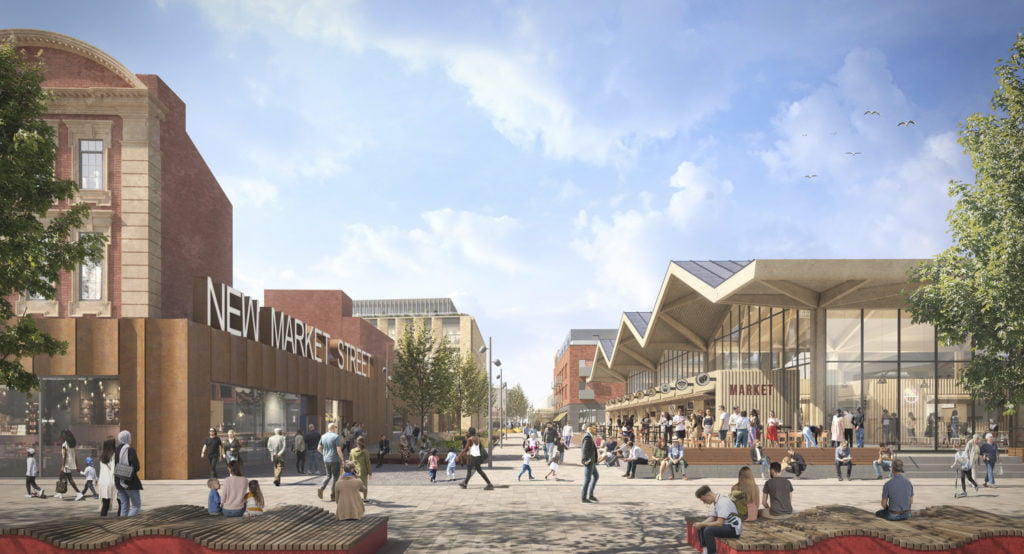
St Helens town centre
Connectivity and travel are shaping the transformation of St Helen’s. It’s not only a transport upgrade, but also an economic intervention that will be fundamental to footfall and accessibility. This strengthens footfall and accessibility for the businesses working in the office spaces, retail, market hall and 120-bed Hampton by Hilton Hotel have the best opportunity to thrive.
Town centres that prioritise connectivity create the conditions for long-term success, as footfall and dwell time are shaped by how easily people can access and move through a place.
The design draws movement past new retail and workspaces generating economic activity and reflects a shift in how modern town centres are structured. Car parks take a back seat, the focus is on public and active travel, with the ambition being to extend connections from cycle hubs into surrounding neighbourhoods over time.
This approach links with investment from the Liverpool City Region Combined Authority through the City Region Sustainable Transport Settlement, alongside national and local funding.
Regional town centres are increasingly under pressure to demonstrate long-term resilience.
In St Helens, we are showing that integrating connectivity from the outset creates stronger environments, greater confidence and long-term foundations, both commercially and socially, for the town centre’s new era.